An advisor at an insurer opens the day to a list somebody else wrote. A follow-up after yesterday's meeting. A renewal that needs a call. A client record with a field that changed overnight. Some of it is a suggestion. Some of it has already happened. If the two look alike on the screen, the advisor starts the day by guessing.
The wording of the suggestion is rarely the trouble. It usually reads well. The question I would ask of the screen is a different one: can the advisor see what the agent did, what it based that on, and how to stop it or take it back? The advisor is the person who answers to the client for the result, so the advisor needs the evidence, not only the sentence.
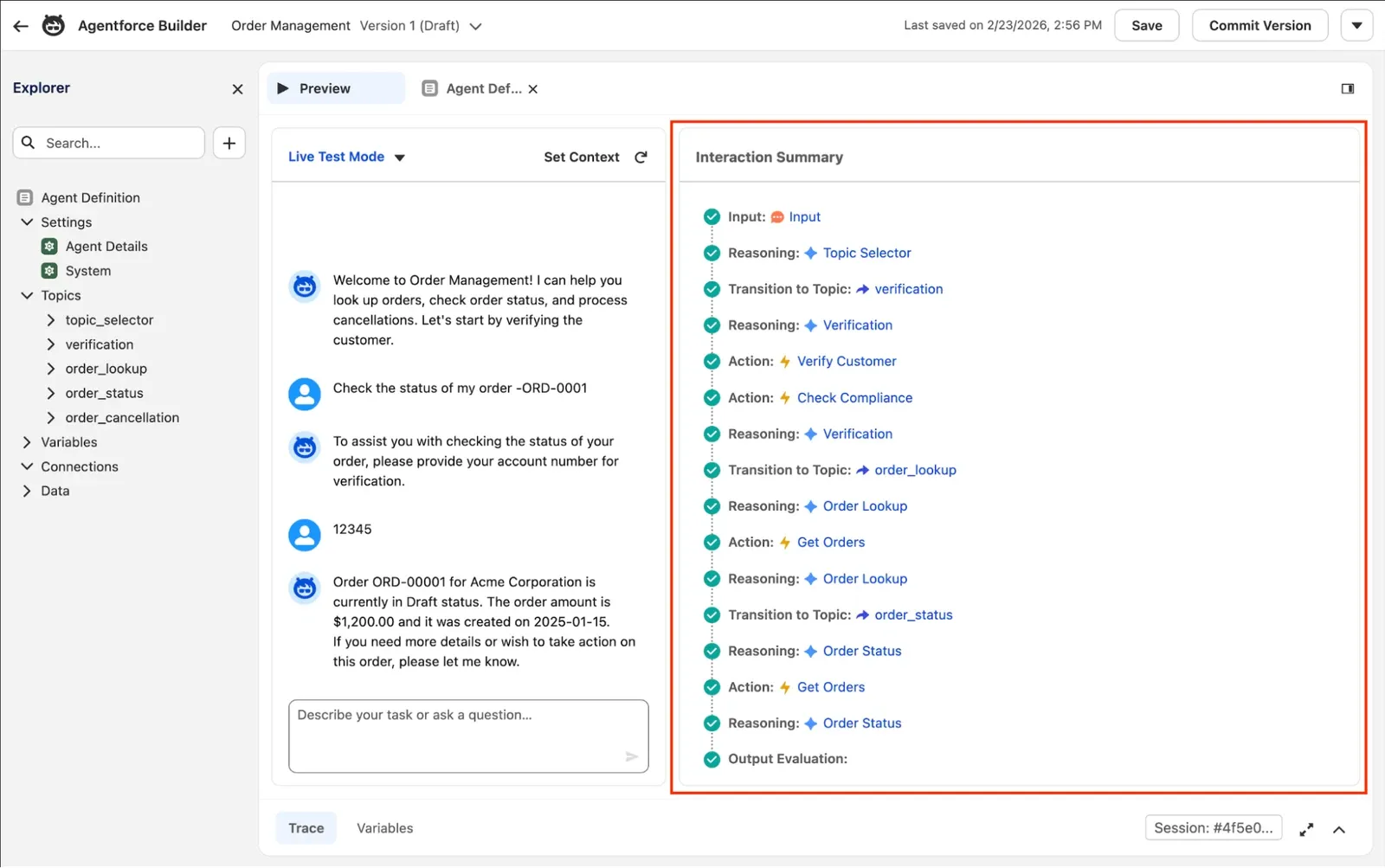
An agent that is allowed to act owes the advisor a receipt for every action it takes.
Why this is still open in November 2026
The agents are here. Agentforce Coworker, the surface for employees inside Lightning, became generally available on 5 November 2026. Trade coverage describes it as an Ask button beside global search, with ways to find things, catch up, and plan and act. For advisors, a set of capabilities was reported in June 2026 that includes help around client meetings and a plan for the day, and coverage of the Winter '27 release reports AI-suggested next steps after meetings. Next best action is moving the same way: the older rule-built product is reported as still documented, and its recommendation flows can be exposed as actions an agent calls.
What the advisor can check has not kept pace. Here is what I could establish, with dates.
- Approval and audit are partial. The 5 November 2026 press release says approvals and audit exist "for supported operations". That phrase is the whole design problem: somebody has to show the advisor which operations those are. Third-party guides report a confirmation on each write and record updates being off by default, but I would not design on a default I have only read about second hand.
- Sources are covered, actions are not. The Lightning Design System now has a section on AI, with agentic patterns, interaction models and conversation design. Its patterns are reported to say that generated content should always show its sources. I could not find published guidance on approval and undo, on a log of actions, or on disclosure specific to financial advice.
- Records as sources are an unknown. A setting to show sources is reported for answers drawn from documents. Whether an answer drawn from CRM records can be cited the same way, I could not confirm. For an advisor, the records are the evidence.
- Waiting and limits are real. A Salesforce help page is reported to list a 60 second limit on an action, a 30 second limit on reasoning, and one intent for each request. Those numbers decide what the waiting state and the failed state have to say.
- Cost is out of sight. Coverage reports that consumption is watched in admin tools and is not shown to the person making the request.
- The rules arrive in 2027. OSFI Guideline E-23 on model risk, published on 11 September 2025, takes effect on 1 May 2027 for all federally regulated financial institutions, life insurers included. It covers AI and machine learning models, vendor models, and explainability scaled to how much autonomy a model has. In Quebec, the AMF issued its final guideline on the use of AI on 7 April 2026, reported to take effect on 1 May 2027. As reported, clients are told when they are dealing with AI, can ask for a human, get a simple explanation, and see AI content labelled.
What I would design
None of this needs a new kind of screen. It needs six plain rules, held on every surface where the agent appears.
- Every suggestion shows its reason and its source records. One line of why, then the records it read, each one a way into the record itself. If the agent cannot name a record, the card says so.
- A clear line between suggests and does. Two different labels, two different looks, never one card that could be either. The advisor should be able to tell from across the desk whether something is waiting or done.
- An approval step sized to the risk. A draft note can be one press. A change to a client record shows the old value and the new one first. Anything that reaches the client goes out under the advisor's name only after the advisor has read it.
- A receipt after every action. What changed, where, when, and an undo for as long as undo is possible. When it is no longer possible, the receipt says that too, and says who can reverse it.
- Honest waiting, partial and failed states. If an action can time out, the waiting state says what is running. If three steps were asked for and two finished, the screen names the two and the one. A request with two intents is answered as one done and one still to ask, not as silence.
- Plain labels on AI-written content. The same words in the same place every time, on the note, the summary and the email draft.
I would also settle with the admin whether the advisor should see what a request costs. I do not know the right answer. I do know it is a decision.
The rule I hold
I would not judge an agent on its best answer. I would judge it on whether an advisor, a week later, can open one client record and say what the agent did there, why, and who approved it. If the screen can answer that, the advisor can trust the list they open in the morning.
Sources
- Agentforce Coworker: a technical deep dive, read November 2026
- Salesforce advisor agents, InvestmentNews, 18 June 2026, read November 2026
- Salesforce Winter '27 release: what to know before go-live, read November 2026
- Next Best Action, Salesforce Help, read November 2026
- Agent considerations and limits, Salesforce Help, read November 2026
- AI and SLDS 2, Lightning Design System, read November 2026
- OSFI Guideline E-23, Model Risk Management, read November 2026
- Quebec's AMF issues guideline on the use of AI for financial institutions, read November 2026