A service agent at an insurer takes a call with two things open: the client's record and a phone. In many Salesforce and Genesys contact centres the phone is one embedded client, Genesys Cloud for Salesforce, built on Salesforce Open CTI. The agent learns it once and stops thinking about it.
That client now has an end date. Genesys announced its deprecation on 23 March 2026, and it retires on 28 February 2028, together with Salesforce Open CTI. Genesys names two paths: CX Cloud from Genesys and Salesforce, or agents working in the Genesys Cloud UI.
It is easy to read that as an upgrade. It is not one. On CX Cloud the call is not in one client. Its controls are shared between Salesforce's own UI and Genesys components that sit inside Salesforce.
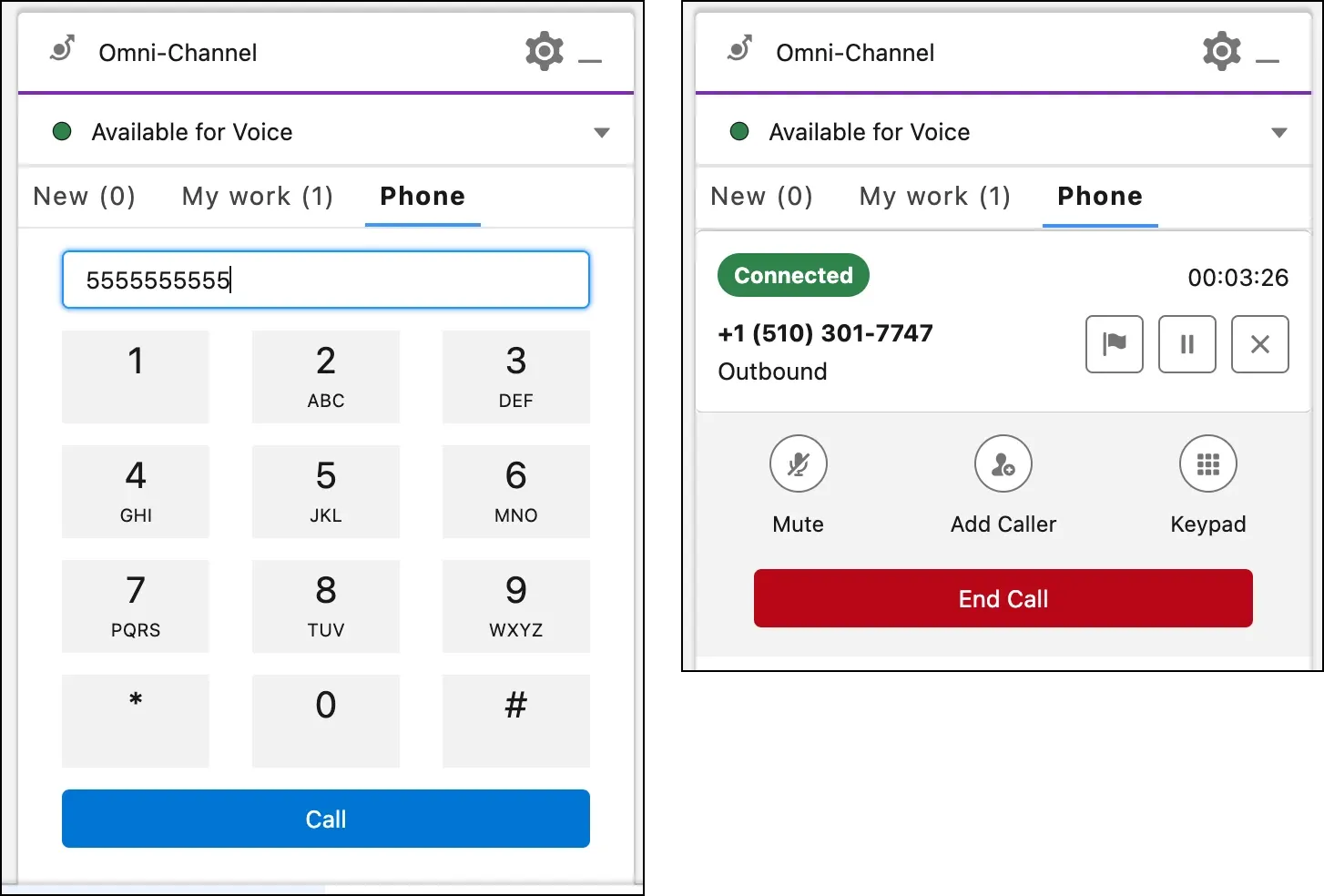
A call that sat in one embedded client now sits across two products, and somebody has to draw the line between them.
One call, two owners
Follow a single call as the agent meets it.
The call arrives in Salesforce's Omni-Channel utility, on its Phone tab. Accept, Hold, Mute, Blind Transfer, Add Caller, Keypad and End Call are all there. So is status: the agent sets presence in Omni-Channel. The record that opens is a Salesforce Voice Call page.
Genesys is on the same screen, in a different place. The Genesys Cloud CX Utility sits in the utility bar and holds phone login, queue activation, callbacks, voicemail and after call work. Transcript, Agent Copilot and Scripter are Genesys components that an admin places on the page. Since 16 November 2026 the Genesys utility also shows presence, routing status and a timer, but read-only. To change status, the agent still goes to Omni-Channel.
None of this is wrong. It is just a lot for one person to hold while a client is talking, and nothing on the screen says which half owns what.
Where it is still open
Much has been fixed this year, and it is fair to say so. A private consult before adding a participant arrived on 27 July 2026. Auto-answer that Genesys controls by queue, campaign or user arrived on 28 September 2026. A wrap-up timer that stuck at 00:00:00 was fixed on 4 November 2026. The latest release note I read is dated 16 November 2026, so the product is moving.
Two things remain open as of this month, and both are design problems more than defects.
The first is wrap-up. After call work can be done in two places: the utility, or a stand-alone after call work component on the Voice Call page. Genesys documents that after the first submit, notes no longer sync between the two systems. The component shows the most recent call across all open tabs, so Genesys recommends keeping one Voice Call tab open at a time. And if the timer expires, the wrap-up is lost.
Read that as the agent. Two places to finish the call. Notes that stop syncing after the first submit. A rule about tabs that lives in documentation, not on the screen. A clock that can discard the work.
The second is the supervisor. A partner answer on the Genesys community, dated 29 April 2026, says listening in on a call is not supported from Salesforce Omni Supervisor. It is done in Genesys Cloud. So a supervisor who works in Omni Supervisor has to go to another product to hear the call.
What I would design
I would start before any configuration, with paper.
- A map of one call. Ring, answer, talk, transfer, wrap up. Under each step, every control and the product that owns it. It names every button, and it is the first thing I would put in front of the admin and the supervisors, because it turns a vague unease into a list of decisions.
- One wrap-up place. Pick the utility or the component, put it in the layout, and leave the other out of the agent's path. Two valid places to finish a call means two habits on one floor, and the note sync rule punishes whoever picks differently on the second edit.
- A timer the agent can see, with a warning. The rule I hold is that software never discards a person's work silently. I would want the remaining time visible next to the notes, a clear warning state before it runs out, and plain words about what happens at zero. What the product allows here is the first thing I would check.
- The tab rule made visible. If one Voice Call tab at a time is the safe way to work, the desktop should make that the easy way, not leave it as a line in training.
- A written supervisor path. While listening in is done from Genesys Cloud, the supervisor's guide says so in one sentence, with the way into Genesys Cloud beside it.
- Old and new side by side. Genesys says both integrations can run in parallel, and that typical migrations take two to four months. I would use that: a small group on the new desktop first, taking real calls, with the map updated from what they trip on.
The date is the easy part
February 2028 sounds far away. Genesys also says its migration guidance is still being written, so the teams that move early will be working some of it out themselves.
That is the reason to treat this as a redesign. The connector will get installed either way. Whether the agent finishes a call calmly, with the notes saved and the client's record right, depends on someone deciding where each part of the call lives, and showing it on the screen.
Sources
- Deprecation: Salesforce Open CTI integration (Genesys announcement), read November 2026
- About CX Cloud from Genesys and Salesforce, read November 2026
- Release notes for CX Cloud from Genesys and Salesforce, read November 2026
- Genesys Resource Center, article 280577, on the agent's controls in Salesforce, read November 2026
- Genesys Resource Center, article 301187, on after call work, read November 2026
- Listen-in from Salesforce Omni Supervisor (Genesys community thread), read November 2026