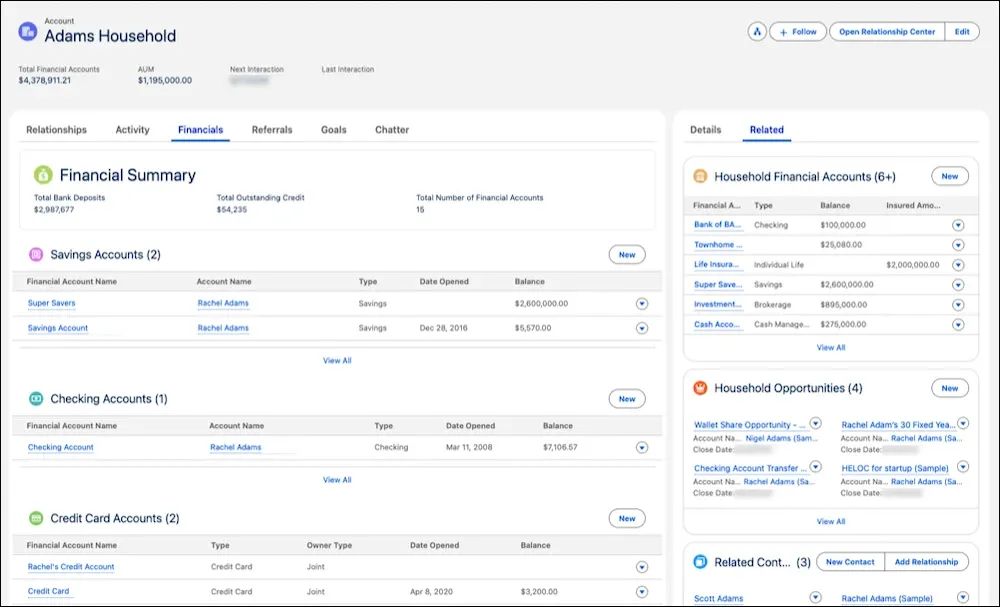
An advisor opens a client's page before a call. The header shows the household, a total, and the policies in force. It looks like one profile, and that is the promise of a Client 360 in Financial Services Cloud: the client, the household and the policies in one place.
Then the client says they moved an account in this morning, and the total on the screen does not include it. Nothing is broken. The number was simply added up earlier, and the page did not say when.
That is the problem I would start with. Not the layout of the page, but the age of what is on it.
Why this is still open in November 2026
The product has a new name. Salesforce's ten-year post of 20 April 2026 brands it Agentforce Financial Services. The household question underneath has not gone away.
Three things sit behind the one clean page.
Totals are computed on a schedule. A partner guide from Vantage Point, dated 19 September 2026, reports that the core rollups (Record Rollup Definitions and the Financial Summary Rollup) run as scheduled Data Processing Engine jobs, so household totals are not real time. The same guide reports a cap of 50 active definitions, and that the older Rollup By Lookup has no retirement date, although Salesforce does not recommend or support customising its rules. The newer engine is a real improvement on the old rules. It is still a job that runs at a set time, and if that time is overnight, the number on the page is last night's.
There are two household models. Trailhead describes the core one: a household is a business account tied to a Party Relationship Group of type Household, and members are linked through Account-Contact relationships. It adds, in its own words, that "Households work differently in the Financial Services managed package." A second Vantage Point guide, from 13 March 2026 and updated 11 November 2026, reports that the managed package has no announced end of life and receives maintenance only, that both models can coexist, and that there is no automated migration tool from Salesforce, only field-mapping Help articles. It also reports that the relationship views differ: Relationship Map on the package side, Actionable Relationship Center on core. So two insurers on the same product can be looking at different household screens.
A person has one primary group. Trailhead again: a person can sit in several groups but "can only have one primary group". A client who belongs to a family household and a business group sees one of them treated as home. Which one is a data decision the advisor did not make and may not know about.
Policies add one more layer. A partner article from Perigeon, dated 7 September 2026, describes Financial Services Cloud as the client layer for insurance, with policy, participant, claim and producer records, and quoting, rating and claims handled by a separate product. Where an insurer keeps its policies in a system outside Salesforce, the policy count on the page is a copy, and a copy has an age too. I could not find a sourced complaint about stale policy data in 2026, so I will not claim one. What I can point to is a user review on AWS Marketplace from 27 October 2026 that describes "a lot of rigidity when integrating external systems". Integration is hard, and the page should not pretend it is invisible.
A number without its age asks the advisor to trust something the screen cannot promise.
What I would design
The first question I ask in discovery is not about the page at all: which household model is this org on, the managed package, core, or both? The screens differ, the relationship view differs, and a design drawn for the wrong one is a design for a product the team does not have.
After that, the rules I would hold:
- Every rolled-up number carries its age and its source. In plain words, beside the number: "as of last night", "from the policy system, synced this morning". Not in a tooltip, and not in a footer the advisor never reaches.
- Live facts and computed facts look different. A phone number read from the record and a total added up by a job are two kinds of thing. I would give each kind a small label in words, with a consistent style, so the difference does not rest on colour.
- The household header says what it is. Which group is primary for this person, who else is in it, and whether the person sits in other groups. One line, at the top, before any number.
- An edit gets an honest state. After the advisor adds a member or an account, the total does not silently stay the same. It says "not counted yet, this total updates overnight", using the org's real schedule. An honest wait is better than a number that looks finished.
- Empty means something specific. "No policies" and "policies not loaded yet" are different sentences, and the page should use the right one.
None of these needs a new engine. They need the schedule and the source, which the admin already knows, written where the advisor reads.
The page should say what it knows
A Client 360 is a claim about completeness. I would rather design a page that makes a smaller claim and keeps it: here is what is live, here is what was added up and when, here is what came from somewhere else.
The advisor can work with a total from last night. What they cannot work with is not knowing that it is.
Sources
- Financial Services Cloud celebrates 10 years, Salesforce blog, read November 2026
- Build Households and Groups, Trailhead, read November 2026
- FSC core vs managed package migration guide 2026, Vantage Point, read November 2026
- Financial Services Cloud rollup engines, Vantage Point, read November 2026
- Salesforce Financial Services Cloud for insurance, Perigeon, read November 2026
- Financial Services Cloud user reviews, AWS Marketplace, read November 2026