A client calls her insurer about a claim. An AI voice agent answers, confirms who she is, takes the claim number and tries to help. It reaches the edge of what it can do and says it will pass her to someone. A service agent picks up and says hello, how can I help.
That question is the failure. The client has already said how. What the service agent can see in that second decides whether the last three minutes counted for anything.
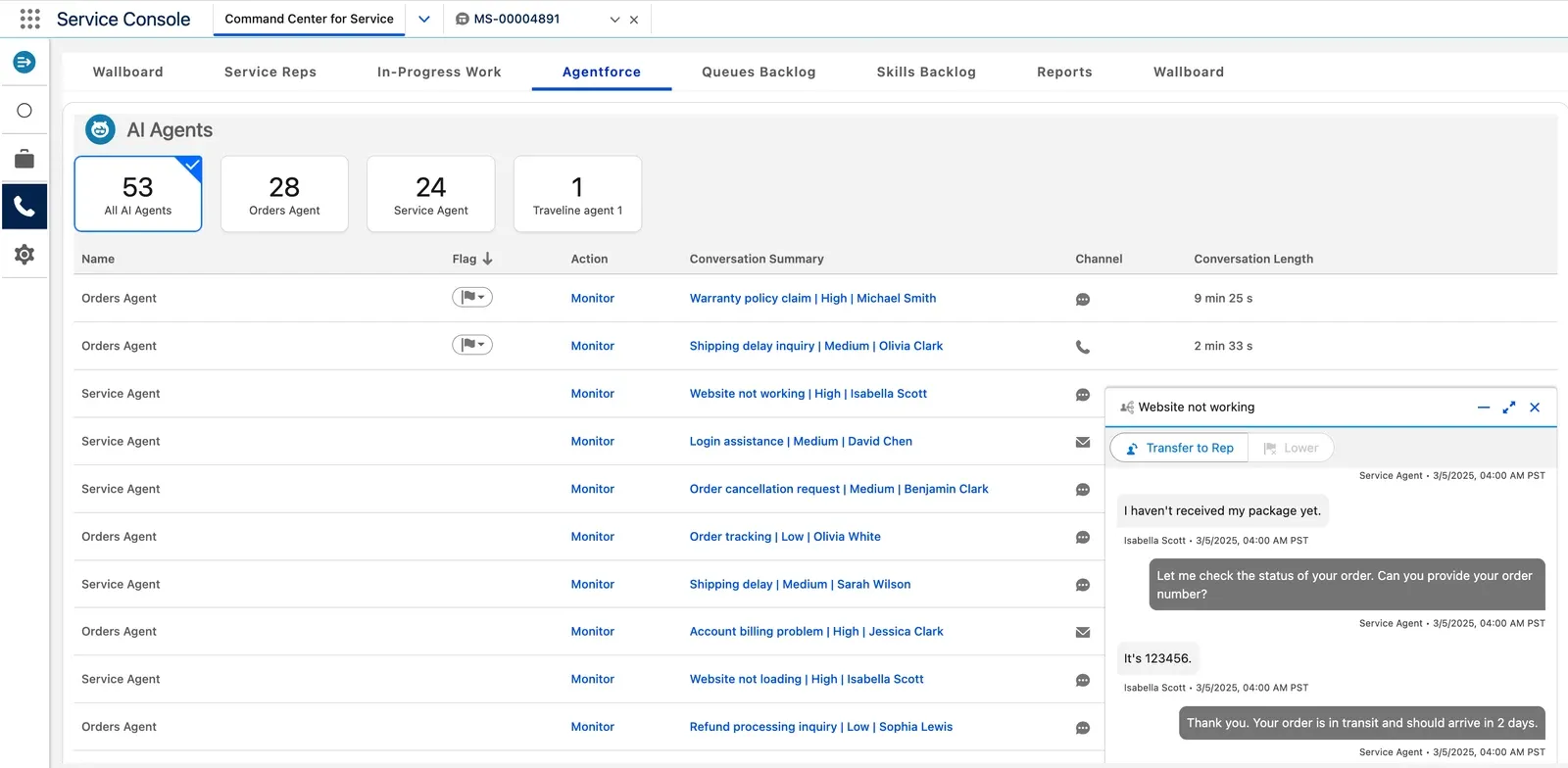
This post is about one handoff on one desktop: Agentforce answering by voice, and a person picking up through Genesys inside Salesforce.
The test of a handoff is whether the caller has to say it again.
One call, separate records
To the client it is one call. To the systems it is not.
In a Genesys community thread, partner replies dated 19 August to 4 September 2026 describe how the pieces connect. The AI voice agent is reached over a separate SIP leg, not through the CX Cloud connector. The caller reaches Genesys. Genesys sends the call to the AI voice agent. When the AI hands off, the call goes back to Genesys, which routes it to a human rep in Salesforce. Each leg gets its own VoiceCall record.
The context does not travel on its own. As described in those threads, it has to be passed across by custom work. In a second thread, a Genesys employee is reported to have called missing escalation context "a challenge", in May 2026. If nobody builds the carrying, the person who picks up may start from nothing.
I also looked for design guidance. The Salesforce design system site has an AI section, republished on 20 November 2026, that lists agentic patterns, interaction models and conversation design. Among what is published there, I could not find guidance on hand-off between agents. So as of this month, the pattern is the team's to design.
Two assistants, one desk
There is a second seam, and it sits on the service agent's screen.
Genesys Agent Copilot offers next best action and knowledge inside Salesforce, as a component that can be placed on the desktop. Salesforce has its own assistance, and it can sit on the same screen. I could not find a page from either vendor on running the two together.
I want to be careful here. I am not reporting a defect, and I have no evidence that the two conflict. It is a design question, and the team has to settle it before the service agent does: when two assistants are present, who speaks?
What I would design
A handoff summary, seen before hello. One card, in the place the service agent already looks when a call arrives. Five lines, always in the same order:
- who is calling
- what they asked
- what the AI already did
- what it could not do
- why it handed off
The card needs honest states. If the summary has not arrived, it says so in words, so the service agent knows to ask rather than assume. An empty panel that looks finished is worse than a plain "no summary for this call".
One conversation timeline. The records can stay separate if that is how the integration works. The person should not have to know. I would stitch the legs into one timeline on the call page: the AI's part first, marked as the AI's, then the live part. The service agent reads one story, top to bottom, and never opens a second record to find the first half.
A rule for the caller's side. The client is told she is moving to a person, in plain words, before it happens. And she is never asked twice for anything she has already given. In Quebec, the regulator's guideline on AI is reported as final in April 2026, and reported to expect that clients are told when they are dealing with AI and can ask for a human. The rule I hold goes one step further: asking for a human should not cost the client her place in the conversation.
One assistant voice per moment. I would settle the two-assistant question on a simple table. Down the side, the moments of a call: the pickup, the conversation, a knowledge question, the wrap-up. Across the top, each assistant. Each cell says speaks or stays quiet, and each row has exactly one speaker. The table is dull on purpose. It turns an argument about products into a decision about moments, and the admin can build from it.
Measure repeats. The test of all of this is one question: did the caller have to say it again? I would count it at the handoff, per call, and treat it as the number the design answers to. Handle time and transfer rates say how the centre is doing. Repeats say whether the handoff worked.
The short version
The AI's best work is wasted if it stops at the edge of a record. The systems may keep the call in pieces. The service agent and the client should still meet one conversation.
Sources
- Genesys community thread on the Salesforce voice connector and Agentforce voice, read November 2026
- Genesys community thread on integrating Genesys Cloud with an Agentforce voice bot over SIP, read November 2026
- Genesys Agent Copilot in Salesforce, Genesys Cloud Resource Center, read November 2026
- About CX Cloud from Genesys and Salesforce, read November 2026
- AI and SLDS 2, Lightning Design System, read November 2026
- Quebec's AMF issues guideline on the use of AI for financial institutions, Blakes, read November 2026